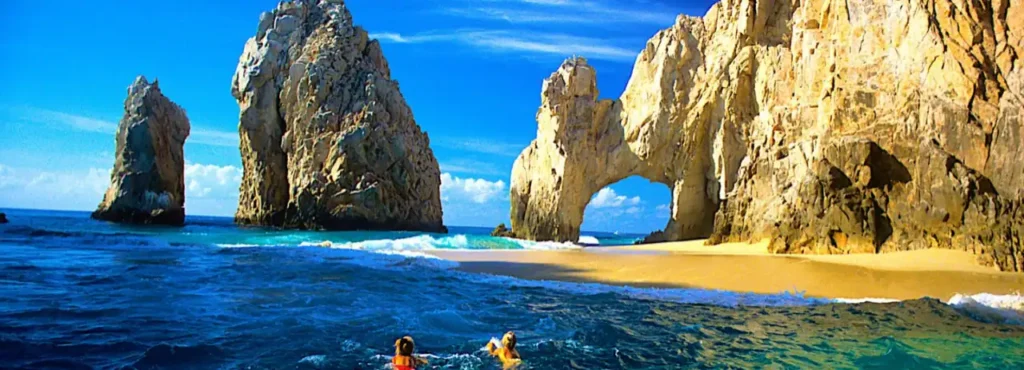
Cabo San Lucas History & Culture
Understanding where Cabo San Lucas came from makes arriving there more interesting — and makes the landscape look different the next time you see it. This is a place with a much longer story than the party-town reputation suggests, shaped by indigenous peoples, Spanish colonial history, a pearl industry, a Hollywood era, and a transformation into one of Mexico’s most visited destinations.
Before Tourism: The Indigenous Foundation
The Baja California Peninsula was inhabited for thousands of years before European contact. The Pericú indigenous people were the primary group in the southern cape region — skilled hunter-gatherers who lived off the sea, the land, and the oases that dot the interior. They had no written language but a rich oral tradition, complex social structures, and a deep knowledge of the marine environment that still informs local fishing practices today.
The Pericú were among the first peoples in Mexico to encounter Spanish explorers in the 16th century. The encounters were brief and often violent, and the indigenous population was significantly reduced by disease and conflict within a few generations.
The Spanish Arrival
The first European to navigate the waters off Cabo San Lucas was Fortún Ximénez, who arrived in 1533 — two decades after Cortés. He was followed by the explorer Juan Rodríguez Cabrillo, who charted the California coast for Spain in 1542 and is often credited with the first European mapping of the Baja Peninsula. The name “Cabo San Lucas” (Cape Saint Luke) dates from this period, named for the saint whose feast day coincided with one of the early voyages.
Spanish colonial settlement in the cape region was limited — Baja California was too dry, too remote, and too far from the silver routes to attract serious colonisation. The missions that were established further north (in today’s Baja California Norte state) had no parallel in Los Cabos, and the region remained a remote frontier for centuries.
Pearls and the Sea of Cortez
What put Los Cabos on the economic map in the 19th and early 20th century was the pearl industry. The warm waters of the Sea of Cortez were home to the Pinctada mazatlanica oyster — the natural habitat of the Cortez pearl, a creature prized across Europe and the United States for its unique iridescence. Pearls from the Sea of Cortez were considered among the finest in the world.
The pearl industry collapsed in the 1940s after a combination of overharvesting and a bacterial blight that devastated oyster populations. It is one of the reasons that the marine environment around Los Cabos is now a protected area — marine sanctuaries like Chileno Bay exist in part because the memory of the pearl crash is still present in the local culture.
Cortez pearls are now being farmed again in small quantities in the Sea of Cortez — a slow, careful revival of something the region lost.
Cabo San Lucas as a Fishing Town
Through the mid-20th century, fishing was the economic centre of Cabo San Lucas. The town grew around the marina and the fish processing facilities that served the commercial fleet. The sea off the tip of Baja was — and remains — extraordinarily rich, and sport fishing grew naturally out of the commercial tradition. The International Bisbee Black and White Marlin Tournaments began in the 1980s and drew an increasingly international clientele to what was still, in those decades, a genuinely small town.
Hollywood took notice in the 1970s and 1980s. The desert-meets-ocean landscape and the glamorous isolation of the cape made it a filming location and a celebrity escape. The resort infrastructure that exists today began to take shape in this period — the tourism chapter of Cabo’s story was beginning to open.
The Modern Era: San José del Cabo and the Tourist Corridor
The broader Los Cabos region today spans a 30-kilometre corridor between San José del Cabo (the quieter, older town to the east) and Cabo San Lucas (the busier town to the west). The two towns are very different in character, and the distinction matters.
San José del Cabo was founded by the Spanish in 1730 and is the historical heart of the region. The historic district — the area around the mission church and the Wednesday evening art walk — is one of the most pleasant small-town centres in Baja. The town has a different rhythm from the coast: slower, more local, less oriented around tourism. The Thursday evening art walk (called the Arte walk) runs from November through March and is one of the best things happening in Los Cabos on any given week.
Cabo San Lucas grew as the tourism centre and the party town — it has more restaurants, bars, clubs, and shops, and the marina is the departure point for almost every boat tour in the region. It can feel like two different destinations depending on where you are in it.
The tourist corridor that connects the two towns is where most of the resort development has happened, and where most visitors spend most of their time driving between beach and restaurant and bar. It doesn’t look like either of the two towns at its centre — it’s a highway with resorts, timeshares, and strip malls flanking it on both sides. Construction is ongoing and has been for decades, which is a fact of life in Los Cabos.
The Food Scene: Mexico’s Best-Kept Secret
One of the most underappreciated aspects of Los Cabos is the food. The restaurant scene here has been transformed over the last 15 years by a generation of Mexican chefs who are cooking at a very high level and getting national and international attention for it. This is not the Mexican food of tourist-zone Tex-Mex — it is serious cuisine from serious cooks using exceptional local ingredients.
The fishing fleet means the seafood is as fresh as it gets. The desert interior produces exceptional vegetables. The climate means year-round access to produce that other regions of Mexico can’t grow in winter. Several restaurants in the San José del Cabo historic district and the surrounding area are regularly ranked among the best in Mexico.
The Culture Today
Los Cabos is still a work in progress in terms of identity. It is simultaneously a world-class resort destination, a working fishing port, a retiree community, an expat enclave, and a growing remote-work location. These communities coexist with varying degrees of friction — the cost of living for local workers has risen sharply with tourism-driven real estate prices, and the tension between local identity and tourism economy is real and ongoing.
The Mexican public holidays and traditions are still observed in the region — Semana Santa (Easter week) is the busiest time of the year, with domestic tourism from Mexico City and Guadalajara peaking. Dia de los Muertos in early November is celebrated throughout the region with altars, flower displays, and family gatherings. The celebration is quieter and more local than in Oaxaca or Mexico City, but it is genuine.
The natural environment — the desert, the sea, the marine life — is the one thing that transcends everything else about Los Cabos. It is what draws people here, and it is what they remember. The Sea of Cortez Jacques Cousteau called “the world’s aquarium” still delivers.