
Cabo San Lucas vs Cancun — Honest Comparison
Two coastal heavyweights that pull millions of visitors every year, and two very different experiences once you’re actually on the ground. Choosing between Cabo San Lucas and Cancun comes down to the kind of holiday you want — not just the price point or flight time. This comparison is as honest as it gets.
The Core Difference
Cancun sits on the Caribbean side of Mexico. It’s flat, tropical, and built around the hotel zone — a long strip of all-inclusive resorts separated from the mainland by a narrow lagoon. The beaches are wide, the water is that clear turquoise you’re picturing right now, and the infrastructure is massive and highly developed. It’s essentially a resort city on a peninsula.
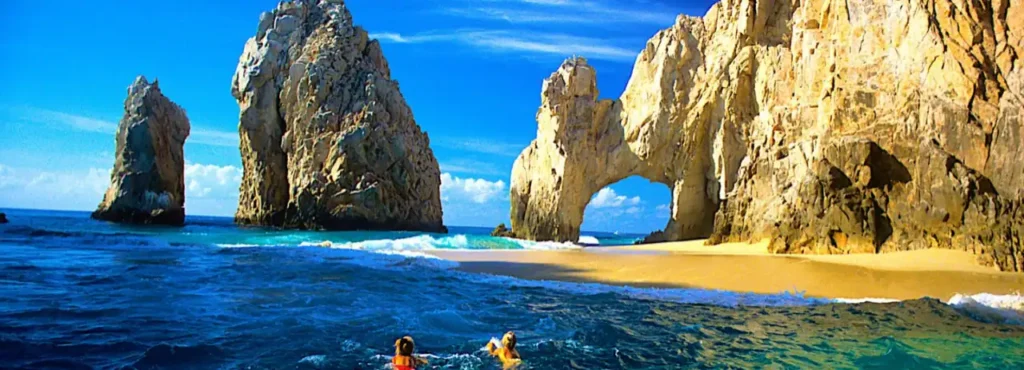
Cabo San Lucas is on the Pacific side of the Baja California Peninsula. It’s rockier, drier, and more dramatic in landscape. The town grew around a marina and a fishing industry, not an all-inclusive resort corridor. Where Cancun has a defined resort zone, Los Cabos (the broader area) is spread across a 30-kilometre tourist corridor between San José del Cabo and Cabo San Lucas. The experience is more varied — a working town with real restaurants, boutique hotels, luxury villas, and a growing food scene. It also has significantly better fishing, more dramatic scenery, and a more established luxury travel infrastructure for high-end travellers.
Beaches
Cancun has the advantage if a classic Caribbean beach is what you’re after — wide, white sand, warm turquoise water. The beaches are long and well-maintained. The downside is that the hotel zone faces the open Caribbean, which can mean larger waves and a stronger current. Not all beaches in Cancun are safe for weak swimmers, and the public beaches can be crowded.
Cabo San Lucas has more variety. The Pacific side beaches are dramatic — sometimes wild and surfable, sometimes calm and sheltered. The Sea of Cortez side has calm, swimmable water at places like Palmilla Beach and Chileno Bay. The tradeoff is that Cabo’s beaches don’t look like a screensaver — the sand is a little darker, the water a little less obviously turquoise. But the marine life is richer, the snorkelling is better, and Palmilla Beach in particular is one of the most consistently pleasant swimmable beaches on the peninsula. Villa Paraiso is a three-minute walk from it.
Weather and Climate
Cancun is hot and humid year-round. The Caribbean climate is tropical — summer temperatures regularly hit 95°F+ with high humidity. Hurricane season runs June through November, with September and October being the most active months. The best time to visit is December through April.
Cabo San Lucas is drier and more temperate. The desert landscape cools more quickly in the evenings, even in summer. Summer is hot but less humid than Cancun. Hurricane risk is lower — the Pacific coast of Baja is less frequently in the direct path of tropical storms. The best time is also November through April, but the shoulder seasons (May and October) are genuinely comfortable in ways they aren’t in Cancun.
Winner on weather: Cabo, particularly for spring and late autumn travel.
Family Travel
Cancun is essentially set up for families who want an all-inclusive resort experience. The large resort chains have kids’ clubs, children’s pools, and activities programmes that run all day. For parents who want to deposit the kids somewhere safe and go off and do their own thing for a few hours, Cancun’s resort infrastructure is hard to beat.
Cabo San Lucas is better for families who want to be out exploring together. The variety of beaches, the whale watching, the snorkelling, Wild Canyon Park — there’s more to do in more varied ways. The private villa model (Villa Paraiso sleeps 14 with seven bedrooms, a private pool, and a full kitchen) is a very different proposition from a hotel room. Families who want a villa with space, privacy, and a concierge who knows their specific needs tend to find Cabo a better fit. Families who want a resort with a kids’ club and organised activities tend to prefer Cancun.
Nightlife and Atmosphere
Cancun has the more famous nightlife. The hotel zone has the clubs and the bar strip, and the scene is loud and large-scale. It’s a party destination for good reason — if you want big clubs, pool parties, and an organised nightlife experience, Cancun delivers.
Cabo San Lucas is lower key. The marina area has a good selection of bars and restaurants, but they’re more varied and less purely club-oriented. There’s a strong food scene — several restaurants in Los Cabos are genuinely excellent and internationally recognised. The overall evening atmosphere is more sophisticated in general, though Cancun wins if a high-energy club scene is the priority.
Golf
Cabo San Lucas is the stronger golf destination. The desert-and-ocean layout of courses like Jack Nicklaus’s Palmilla course and theQuerencia golf club are two of the best golf experiences in Mexico. Several courses are ranked among the best in Latin America. Golf travellers specifically seeking a high-end golf trip tend to choose Los Cabos over Cancun.
Cancun has good golf — courses in the Riviera Maya are solid — but the overall concentration of high-end golf design is stronger in Los Cabos.
Fishing
Cabo San Lucas wins decisively here. The Sea of Cortez is one of the world’s great sportfishing environments — it’s called the Marlin Capital of the World for good reason. Blue marlin, black marlin, striped marlin, yellowfin tuna, dorado, wahoo — all available year-round, with peak seasons that draw serious anglers from around the world. The fishing fleet out of Cabo San Lucas is professional and well-established. This is not a close contest.
Cancun has some fishing but it’s not the primary draw and the variety and consistency is lower than Los Cabos.
Cost
Cancun offers a wider range of pricing. The all-inclusive model can be very cost-effective for families — you pay upfront and your food, drinks, and activities are included. At the luxury end, the large resort brands offer excellent facilities but at high list prices.
Cabo San Lucas tends to skew more expensive for independent travel — restaurants and activities are priced for the tourist market. However, for groups and families who fill a large villa, the per-person cost compares favourably to multiple hotel rooms, especially when you factor in the kitchen and the private facilities. The all-inclusive model is less common in Los Cabos, which means more flexibility but also more variable pricing.
Getting There
Cancun has one of the busiest airports in Latin America. Direct flights from the US are abundant — most major US cities have non-stop service. Flight time from New York is about 4 hours; from Los Angeles about 5 hours. The airport is large and the resort zone is 20–30 minutes away.
Cabo San Lucas uses San José del Cabo International Airport (SJD), about 40 minutes north of Cabo San Lucas in the tourist corridor. There are fewer direct flights than Cancun but the airport handles the demand well. Flight time from Los Angeles is about 2.5 hours; from New York about 5.5 hours.
Winner for ease of access: Cancun, for US East Coast travellers in particular. For West Coast travellers, the difference is negligible.
Which Should You Choose?
Choose Cancun if: you want an all-inclusive resort experience, you’re prioritise classic Caribbean beaches, you want the widest range of flight options, and your group is happy within a resort property.
Choose Cabo San Lucas if: you want a more varied and sophisticated travel experience, you’re interested in fishing or golf, you prefer private accommodation over hotels, you want dramatic scenery and better food, and you’re travelling as a family or group who wants flexibility and space.
Many travellers who’ve done both say they prefer Cabo. Many first-time visitors who went to Cancun and want to try something different find Los Cabos is exactly the right next step.